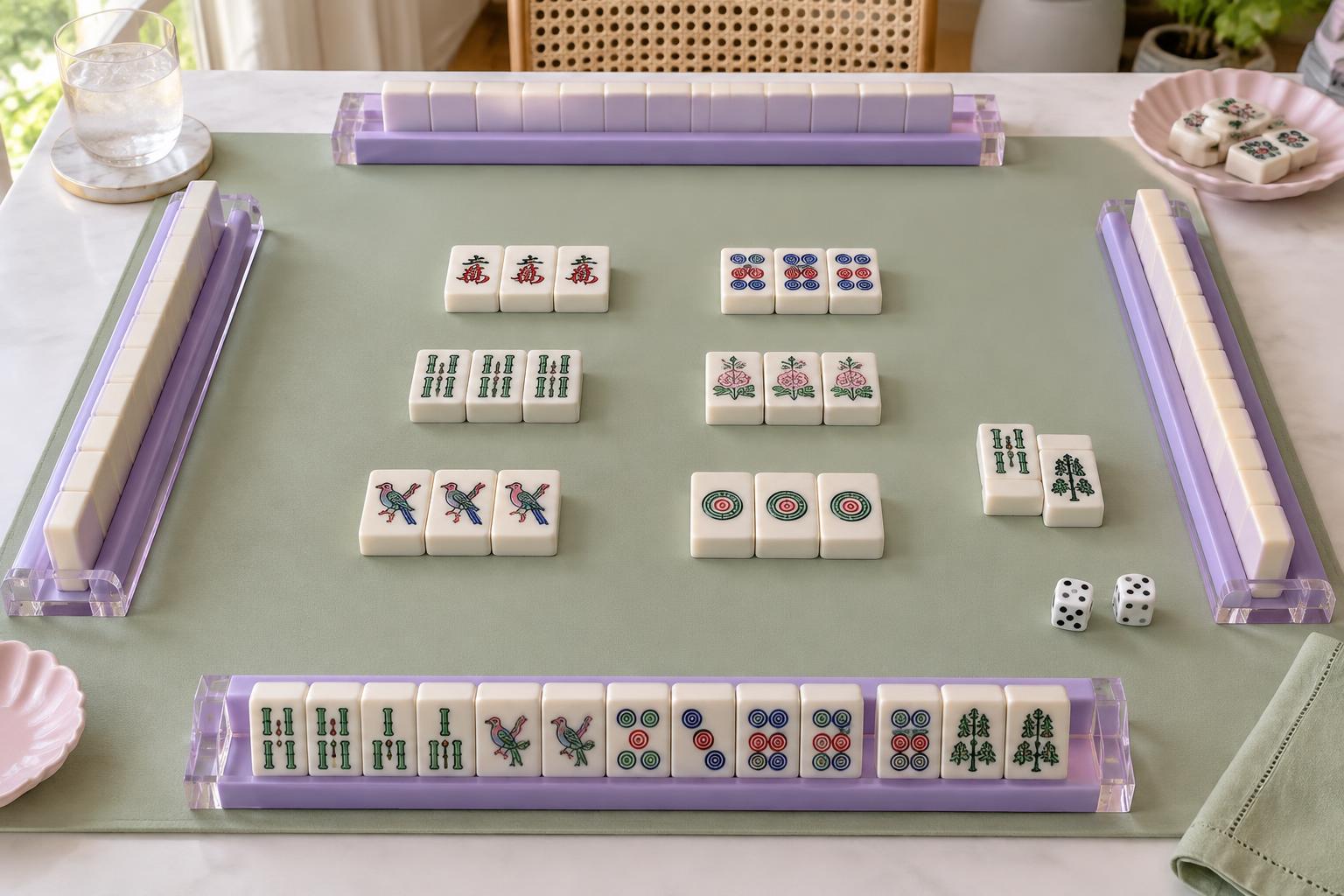
Six phases · One table
Learning
American Mahjong
You don’t have to learn everything at once. Start with what you can see, then build the game one layer at a time.
Your learning path
One layer gives the next a place to land.
Physical handling, game flow, and vocabulary are easier to absorb separately. First watch and handle the equipment, then follow a whole game. Tile names and rules come after those things feel familiar.
Phases 1 and 2 can be done in either order. Visual or social learners may prefer watching; tactile learners may prefer meeting the table. Complete both before Phase 3.
0%
0 of 27 milestones
Watch
What does a game look and feel like?
Meet the Table
What is each object, and what is it for?
See the Big Picture
What happens in a game, start to finish?
Learn the Language
What are the names, groups, card, and rules?
Play Smarter
How do I play without feeling lost?
Find Your Table
How do I make this a regular part of life?
Where the game comes from
A Chinese game.
An American tradition.
Mahjong developed in nineteenth-century China. The American version was standardized by the National Mah Jongg League, founded in 1937 by Jewish women in New York. Its annual card, jokers, passing round, and racks distinguish it from other versions.
Before you begin
You don’t need to buy a set to start. Watching needs no equipment, and many lessons supply sets.
American Mahjong is not the single-player tile-matching game called Mahjong solitaire. Look specifically for American or NMJL play when searching for videos and practice.
Every player needs a current card when playing. Buy directly from the National Mah Jongg League for membership and the annual bulletin.
For Phase 4 onward
The learning glossary
Bam: bamboo suit tile, 1–9; 1 Bam usually shows a bird.
Bettor: fifth player who sits out and bets on a player.
Blind pass: passing received tiles unseen; first left and last right only.
Call: claiming the most recent discard.
Card: the annual NMJL list of winning hands.
Charleston: the required pre-play tile passing (first round) plus optional second round and courtesy pass.
Cold wall / hot wall: house rules, not NMJL rules.
Concealed (C): a hand with no exposures; only the winning tile may be called.
Courtesy pass: optional 0–3 tile exchange across the table after the Charleston.
Crak: character suit tile, 1–9; pairs with Red Dragon.
Dead hand: a hand declared unplayable by an opponent; player stops play but still pays.
Discard: a tile put face up in the center.
Dogging: defensive play that sacrifices your own hand.
Dot: circle suit tile, 1–9; pairs with White Dragon.
Down: a discard that has touched the table or been named.
Dragon: Red, Green, or White; four each.
East: the dealer; starts with 14 tiles and discards first.
Exposure: a called group placed face up on the rack.
Flower (F): one of 8 interchangeable tiles.
Floor: the discard area.
Heavenly Hand: East declaring Mahjong before the Charleston.
Hot tile: a tile likely to complete an opponent's hand.
Joker: one of 8 wild tiles; groups of 3+ only.
Joker exchange: swapping a natural tile for a joker in an exposure, on your turn, after picking.
Kong: 4 identical tiles.
Like numbers: the same number across groups.
Line: one hand on the card.
Line finder: an accessory that highlights one line of the card.
Mahjong: the declaration of a completed hand; also the game's name.
Natural: any non-joker tile.
NEWS: one each of North, East, West, South; no jokers.
NMJL: National Mah Jongg League, founded 1937.
Pair: 2 identical tiles; no jokers.
Pung: 3 identical tiles.
Pusher: rack arm used to push the wall forward.
Quint: 5 identical tiles.
Rack: tile holder; "racking" a tile closes the window to call the prior discard.
Self-pick: drawing your own winning tile (includes winning via joker exchange).
Sextet: 6 identical tiles.
Shuffler: flat paddle used in pairs to mix tiles.
Singles & Pairs: concealed, jokerless section; highest values.
Soap: White Dragon; zero in year hands.
Wall: the 19-long, 2-high rows of face-down tiles.
Wall game: a game with no winner; no one pays.
Window of opportunity: the time during which a discard may be called.
Year hand: a hand built on the current year's digits, using Soap as zero.
Sources & edition notes
Based on the owner’s master source, version 1.0, October 2026. Annual card, price and platform details refer to the 2026–2027 edition and should be checked each spring. NMJL card hands are copyrighted and are not reproduced here. The current card and official rulebook remain the authority for play.
Official
- National Mah Jongg League: nationalmahjonggleague.org (League, Store, Mail Order, Game, FAQ pages)
- NMJL Digital Subscription Policy (NMJL Online)
Rules authorities
- Tom Sloper, Sloperama FAQ 19 (American Mah-Jongg rulings index): sloperama.com/mjfaq/mjfaq19.html
- Tom Sloper, FAQ 7i (cards) and weekly columns (#783, #793), sloperama.com
- The Mahjong Line, American Mahjong FAQs (rulings compilation): themahjongline.com/pages/the-big-card-american-mahjong-faqs
- I Love Mahj rules Q&A: ilovemahj.com
- Lara's Mahjong Edit (card reading, joker rules, scoring, etiquette): larasmahjongedit.com
- Mahjongg Rules printable summary: sites.google.com/site/mahjrules
Equipment
- Yellow Mountain Imports (tile mixers/shufflers, pushers): ymimports.com
- Miss Mahjong (rack sizing): missmahjong.com
- My Fair Mahjong (shuffle cards): myfairmahjong.com
- Oh My Mahjong (line finders, kits): ohmymahjong.com
- Set buying guides: mahjongcompare.com, mischiefmahj.com, goldielox.com
Strategy and learning
- Mahjong Playbook (strategy, defense, card tips): mahjongplaybook.com
- Bam Good Time (strategy, apps, etiquette): bamgoodtime.com
- Salt Lake Mahjong Club (2026 card analysis; learning): saltlakemahjongclub.com
- Mahjong Rules (learning curve, platform reviews): mahjong-rules.com
- Mahjong Compare (teachers, lessons, events): mahjongcompare.com
History and trends
- Annelise Heinz, Mahjong: A Chinese Game and the Making of Modern American Culture (Oxford University Press, 2021)
- Tablet Magazine, "How Mahjong Became American—and Jewish"
- NPR, January 24, 2026
- CNN, September 19, 2026
- Axios Houston, July 18, 2025; Axios Miami, March 18, 2026
- The Washington Post, July 24, 2025
- Coyote Media; The Mahjong Project (cultural critique)