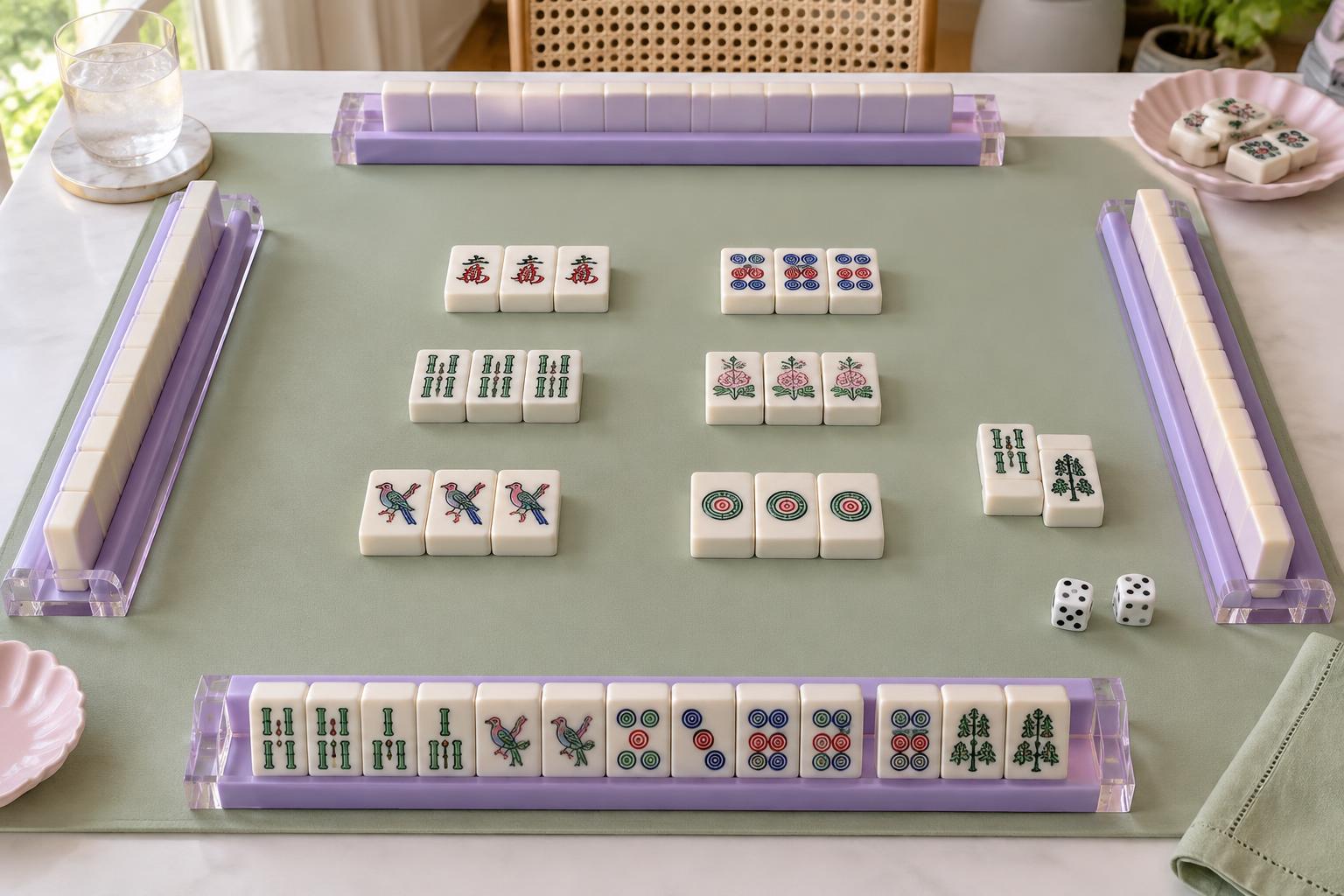
Table
- Four players, one per side of a square table. A standard card table works.
- Each player needs room for a rack and a row of tiles in front of it; the center stays open for tiles put down during play.
- With a rectangular table, two players can share each long side by angling racks into a diamond.
Mat
- Covers the table.
- Jobs: quiets the sound of heavy tiles; protects the table and tile faces; defines the play area; lets tiles slide smoothly during mixing.
- Some mats print beginner reminders (passing order, joker rules).
- Not required by the rules.
Racks (4)
- One per player; a long, narrow holder.
- Jobs:
- Holds a player's tiles upright, facing the player, hidden from others.
- The flat top surface is a shelf where certain tiles are placed face up for everyone to see during play (explained in Phase 3).
- Serves as a guide for building the row of tiles in front of it: each player's row is 19 tiles long, and racks are sized to match (commonly 18–20 inches; large-format tiles generally need 19–20 inch racks).
- Materials: wood, acrylic, plastic.
Pushers
- Long arms attached to the rack (often pinned or magnetic) or separate bars; also called "extending arms" or "helping hands."
- Job: swing out to straighten the row of tiles and slide the entire row toward the center in one motion without it falling apart.
- Optional, but widely used.
Tiles
- 152 tiles are used in play.
- Many sets ship with 160 or 166 tiles (extra jokers or blank spares). This is packaging, not a rules difference.
- Job: the playing pieces, comparable to cards. Players collect, trade, and arrange them to match a winning pattern.
- Visible kinds: numbered tiles 1–9 in three designs; tiles with letters N, E, W, S; three special bold designs; flower tiles; tiles marked JOKER.
- American sets have Arabic numerals and English letters printed on tiles.
- A set without jokers (usually 144 tiles) is a Chinese set and can't be used for American Mahjong without adding jokers. An American set can play Chinese mahjong by removing the jokers.
- Hands-on activity: sort tiles face up into identical groups.
Dice (2)
- Jobs: decide who goes first (starts as dealer), and decide where tile distribution begins. Not used again until the next game.
The card
- A small folded card listing every winning hand for the year. Every player needs their own.
- Job: the goal of every game is to collect tiles that match one line on the card.
- Published new each spring by the NMJL. Same game, new winning patterns. Release timing is reported as late March to April.
- Sizes: standard and large print; identical hands. Large print is easier to read at the table. 2026 prices from the League: $14 standard, $15 large print; an 8.5×11 "Mega Card" is $35.
- Buy directly from the NMJL (nationalmahjonggleague.org or by mail). Doing so makes the buyer a League member for the year and includes the annual bulletin with rules clarifications.
- Resellers (local shops, teachers) charge more for convenience ($15–$20). Counterfeit cards are sold on marketplaces; recommend buying from the League or a clearly authorized seller.
- Alternative cards exist (The Big Card, Marvelous Mah Jongg, AMJA, Mah Jongg Press). Leagues, lessons, and tournaments use the NMJL card.
Line finder (line reader)
- A slim overlay or slider that highlights one line of the card. Many are sized for both standard and large NMJL cards.
- Job: keeps a beginner's eye on the one hand they're working toward.
- Optional accessory.
Shufflers (tile mixers)
- Flat, stiff paddles, roughly 5.5 × 7 inches, typically used in pairs.
- Job: slide under the face-down tiles, lift, and mix. Makes mixing faster, spares fingernails, and saves players from using their cards to shuffle.
- Optional; many tables mix by hand.
Coins, chips, or scorecard
- Job: track winnings. Small stakes are traditional (e.g., a 25-point hand = 25 cents); many groups keep score on paper or play for no money.
Card holder / sleeve
- Job: holds the card upright or protects it. Optional.
Case or bag
- Job: storage and travel.
Assembled-table summary
Square mat on a card table; four racks, one per side, each with a card nearby; two dice and coins to the side; tiles face down in the middle before mixing.
Ready for the next phase?
0 / 4Still need to watch? Go to Phase 1.
Use the current card and Mah Jongg Made Easy for current rulings.